
Table of Contents
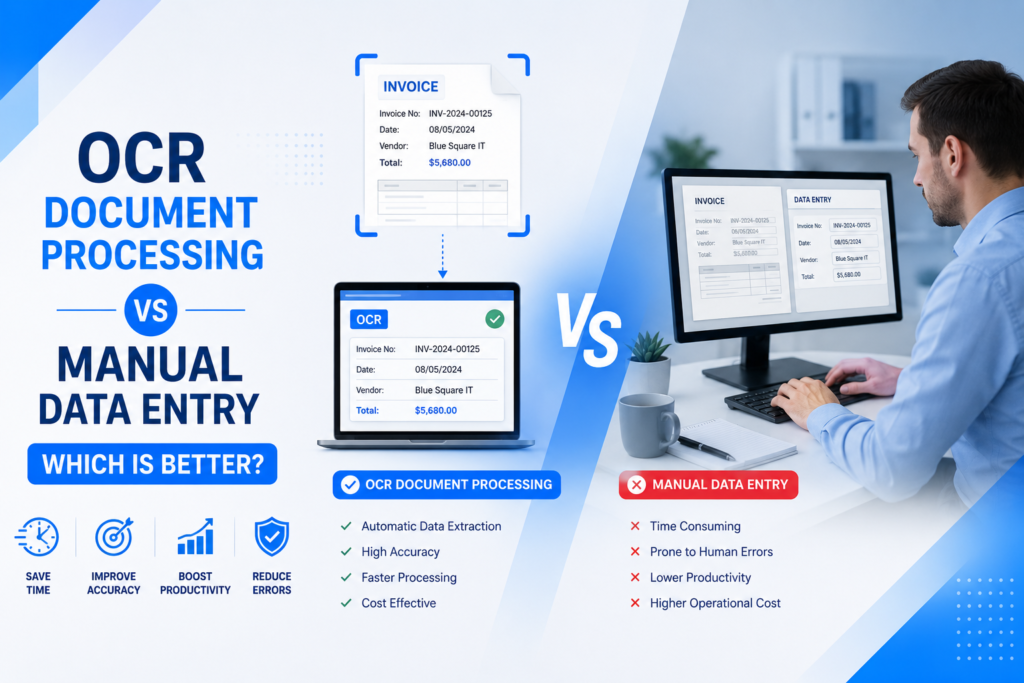
ToggleOCR Document Processing vs Manual Data Entry: Which Is Better?
What Is OCR Document Processing?
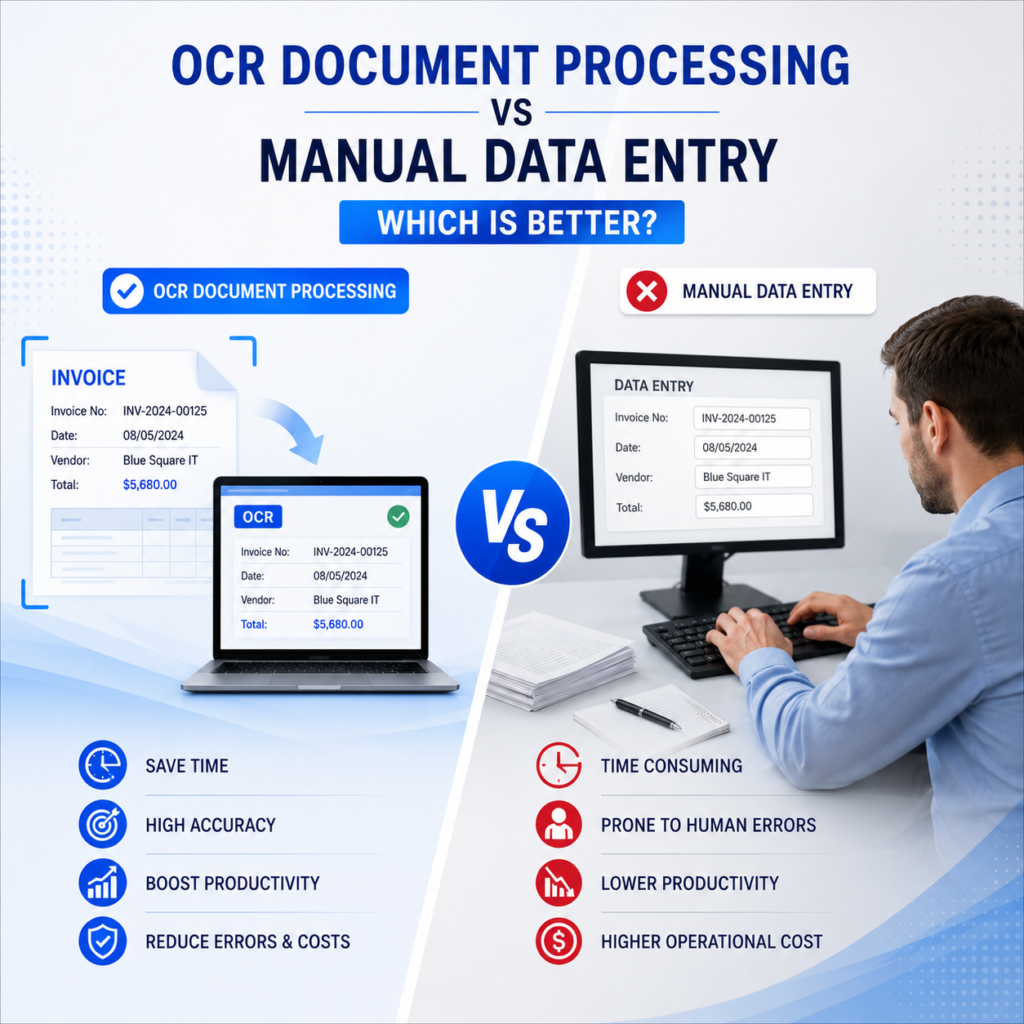
OCR Document Processing uses Optical Character Recognition (OCR) technology to convert printed or handwritten text into searchable, editable digital data. When combined with artificial intelligence, OCR can automatically identify document types, extract key information, and route documents through predefined workflows.
Businesses use OCR to process invoices, purchase orders, contracts, receipts, HR files, medical records, and many other document types, reducing the need for repetitive manual data entry.
For organizations managing large document volumes, OCR has become a critical component of digital transformation.
What Is Manual Data Entry?
Manual data entry involves employees reading information from physical or digital documents and typing it into spreadsheets, ERP systems, CRM platforms, or databases.
Although this method requires minimal technology investment, it often becomes inefficient as document volumes increase. Human operators may introduce errors, processing delays, and inconsistencies, particularly when handling repetitive tasks.
OCR Document Processing vs Manual Data Entry
| Feature | OCR Document Processing | Manual Data Entry |
|---|---|---|
| Speed | ✔ Processes thousands of documents quickly | Slow for large document volumes |
| Accuracy | ✔ High accuracy with AI validation | Depends on operator accuracy |
| Cost | ✔ Lower long-term operational costs | Higher labor costs |
| Scalability | ✔ Easily handles growing workloads | Requires additional staff |
| Searchability | ✔ Creates searchable digital records | Often requires manual organization |
| Workflow Automation | ✔ Integrates with automated workflows | Mostly manual processes |
9 Benefits of OCR Document Processing
1. Faster Processing
OCR extracts information in seconds instead of minutes per document.
2. Higher Accuracy
Modern AI-powered OCR minimizes transcription errors and improves data consistency.
3. Reduced Operational Costs
Automating repetitive data entry allows employees to focus on higher-value activities.
4. Better Productivity
Teams spend less time entering data and more time reviewing insights or serving customers.
5. Improved Compliance
Digital records support audit trails, document retention policies, and regulatory requirements.
6. Enhanced Search Capabilities
OCR converts documents into searchable text, making information retrieval much faster.
7. Seamless System Integration
OCR solutions can feed extracted data directly into ERP, CRM, and business applications.
8. Scalable Operations
Whether processing hundreds or millions of documents, OCR scales without proportional increases in staffing.
9. Supports Digital Transformation
OCR is a foundational technology for intelligent document management and workflow automation.
When Manual Data Entry Still Makes Sense
Despite the advantages of OCR, manual data entry may still be appropriate in certain situations, including:
- Processing a very small number of documents
- Reviewing handwritten notes with poor image quality
- Validating extracted information during quality assurance
- Handling highly customized forms that require human judgment
In many organizations, the most effective approach combines OCR with human verification for exceptional accuracy.
Which Option Is Better?
For businesses handling frequent invoices, contracts, HR records, or compliance documents, OCR Document Processing offers clear advantages in speed, accuracy, and cost efficiency.
According to IBM, intelligent document processing combines OCR with artificial intelligence to automate document-intensive workflows, helping organizations reduce manual effort while improving operational efficiency.
External Reference:
https://www.ibm.com/think/topics/intelligent-document-processing
As document volumes continue to grow, AI-powered OCR enables organizations to process information faster and make business data available in real time.
How BSIT Helps Businesses Automate Document Processing
Organizations looking to move beyond manual document handling can benefit from BSIT’s AI eDMS solution, which combines Zonal OCR, AI-powered indexing, intelligent search, and workflow automation to streamline document processing and improve operational efficiency. Rather than simply digitizing files, the platform helps businesses organize, retrieve, and manage information securely across departments.
For businesses planning broader digital transformation initiatives, BSIT also provides AI Chat With Database solutions that allow users to retrieve business insights from ERP systems and databases using natural language, complementing intelligent document management with conversational analytics.
Zonal OCR
Workflow automation
Intelligent document search
Secure document access
Enterprise integration
AI-powered document processing
By combining AI with enterprise-grade document management, BSIT enables organizations to reduce manual effort, improve compliance, and accelerate digital transformation
Frequently Asked Questions
Is OCR more accurate than manual data entry?
Modern AI-powered OCR can achieve very high accuracy on structured documents and significantly reduces repetitive typing errors. Human validation may still be useful for low-quality or handwritten documents.
Can OCR integrate with ERP systems?
Yes. Many OCR solutions integrate directly with ERP, CRM, accounting, and document management platforms, allowing extracted data to flow automatically into business systems.
Which industries benefit most from OCR Document Processing?
Industries such as finance, healthcare, construction, manufacturing, logistics, retail, and government organizations benefit significantly from OCR because they process large volumes of business documents.