
Table of Contents
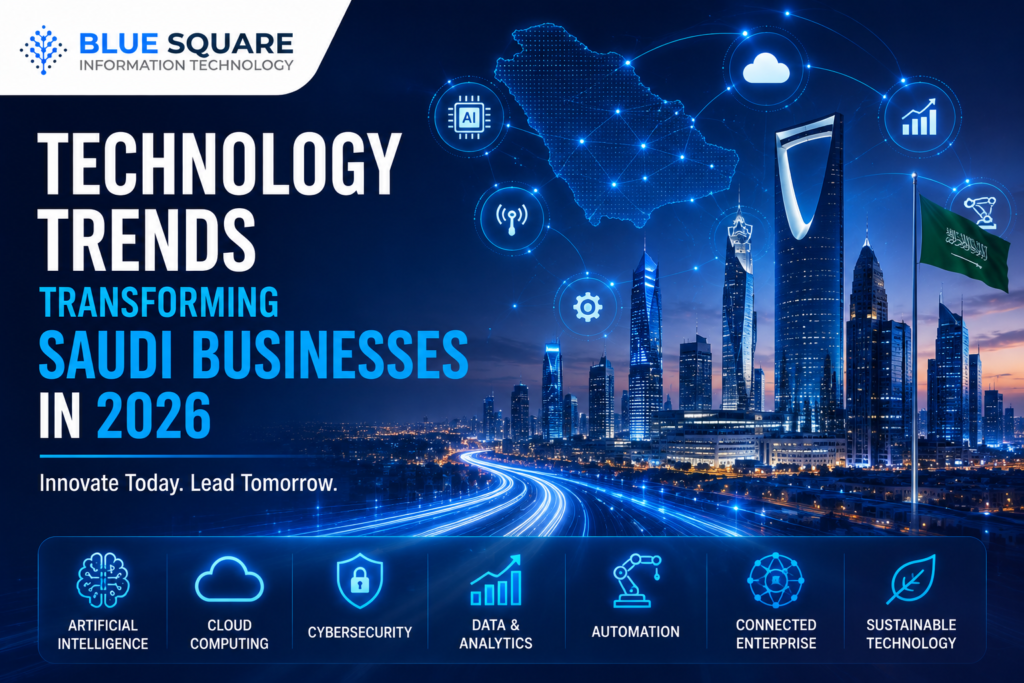
ToggleTechnology Trends Transforming Saudi Businesses in 2026
Introduction
Saudi Arabia is rapidly becoming one of the region’s leading digital economies. Driven by Vision 2030, businesses are adopting artificial intelligence, cloud computing, cybersecurity, IoT, 5G, automation, and advanced analytics to improve efficiency and competitiveness.
The U.S. International Trade Administration reports strong growth in Saudi Arabia’s ICT sector, alongside widespread internet and 5G adoption. These developments are creating new opportunities for businesses across industries. U.S. International Trade Administration: Saudi Arabia Digital Economy
So, what are the key Saudi Arabia Technology Trends businesses should watch in 2026?
Key Technology Trends in Saudi Arabia
1. Artificial Intelligence
AI is becoming a strategic technology for Saudi businesses. Organizations are using AI for automation, customer service, forecasting, fraud detection, analytics, and operational optimization.
Saudi Arabia has identified AI as a major national priority as part of its digital transformation strategy.
2. AI-Powered Analytics
AI is becoming a strategic technology for Saudi businesses. Organizations are using AI for automation, customer service, forecasting, fraud detection, analytics, and operational optimization.
Saudi Arabia has identified AI as a major national priority as part of its digital transformation strategy.
3. Cloud Computing
Cloud adoption continues to grow as businesses seek scalable and flexible infrastructure.
Saudi Arabia’s Cloud First Policy and continued investment in cloud infrastructure are accelerating this transition. Saudi Arabia Digital Economy Guide
Cloud platforms also provide the foundation for AI, analytics, enterprise applications, and digital services.
4. Cybersecurity
As businesses become more digitally connected, protecting systems and data is increasingly important.
Saudi organizations are investing in:
Cloud security
Data protection
Identity management
Network security
Threat detection
Security monitoring
Cybersecurity is becoming a core part of digital transformation rather than simply an IT function.
5. 5G and Advanced Connectivity
Saudi Arabia has invested heavily in 5G infrastructure, creating opportunities for connected devices, smart facilities, real-time monitoring, and industrial applications.
5G also supports the growth of IoT, automation, and other data-intensive technologies.
6. IoT and Smart Operations
The Internet of Things (IoT) connects equipment, vehicles, sensors, and business systems.
Saudi businesses can use IoT for:
Predictive maintenance
Fleet tracking
Asset monitoring
Warehouse management
Industrial operations
IoT is also an important technology behind the Kingdom’s smart-city developments.
8. Smart Cities and Intelligent Infrastructure
Large Saudi developments such as NEOM, Qiddiya, and The Red Sea are incorporating AI, IoT, cloud computing, analytics, and connected infrastructure.
These projects are creating opportunities across construction, logistics, tourism, healthcare, energy, and other industries.
7. Business Automation and Low-Code
Businesses are increasingly automating repetitive processes such as approvals, document workflows, data entry, and internal requests.
AI-powered low-code and no-code platforms allow organizations to build applications and automate workflows faster.
BSIT’s AI Low-Code/No-Code Platform supports application development and business process automation with reduced dependence on traditional coding.
10. Intelligent Document Management
Digital transformation also means managing increasing volumes of business documents and information.
9. Digital Commerce and Payments
E-commerce, digital banking, and electronic payments continue to expand across Saudi Arabia.
Businesses are investing in digital storefronts, online payments, customer applications, and automated digital experiences.
AI-powered document management can support:
OCR
Document classification
Metadata extraction
Digital archiving
Workflow automation
Secure document access
BSIT’s AI eDMS combines document management with AI, OCR, workflow automation, and secure information management.
What These Trends Mean for Businesses
The biggest opportunity is not adopting every new technology separately. It is connecting technologies to solve business problems.
For example:
IoT
Cloud
Data
AI Analytics
Automation
Businesses should therefore focus on:
Modernizing IT infrastructure
Building reliable data foundations
Strengthening cybersecurity
Automating repetitive processes
Integrating ERP, CRM, databases, and business applications
DataSack’s analysis of Saudi Arabia’s technology landscape similarly highlights cloud, AI, cybersecurity, automation, IoT, and digital infrastructure as important components of the Kingdom’s transformation.
Why BSIT for Digital Transformation?
BSIT helps Saudi organizations adopt and integrate technologies across their IT environment, including AI Analytics, AI Chat With Database, AI eDMS, AI Low-Code/No-Code, ERP, Cloud, Database, Infrastructure, BCDR, and Managed IT Services.
Rather than treating each technology as a separate project, BSIT can help organizations build a connected technology environment aligned with their business objectives.
Frequently Asked Questions
What are the major technology trends in Saudi Arabia in 2026?
The major trends include AI, cloud computing, cybersecurity, AI analytics, IoT, 5G, smart infrastructure, automation, digital payments, and intelligent document management.
Why is AI important for Saudi businesses?
AI can help organizations automate processes, analyze data, improve forecasting, and make faster business decisions.
Is cloud adoption increasing in Saudi Arabia?
Yes. Cloud computing is a major part of Saudi Arabia’s digital transformation and is supported by national initiatives such as the Cloud First Policy. Saudi Arabia Digital Economy Guide