
Table of Contents
ToggleOn Premise vs Cloud
Which Infrastructure Is Better for Your Business?
Introduction
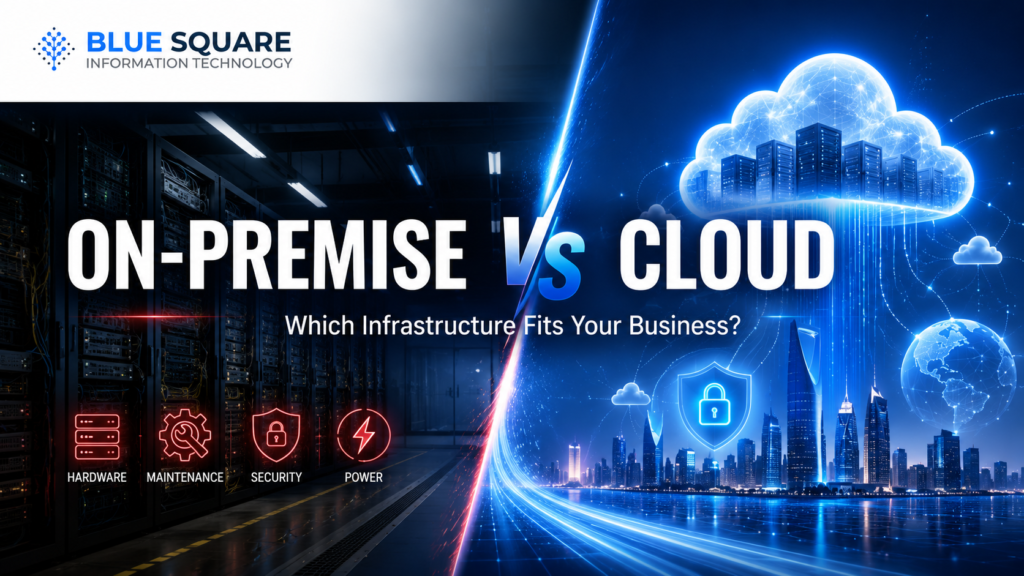
As organizations modernize their IT environments, one of the most important technology decisions they face is choosing between on-premise infrastructure and cloud infrastructure. While both approaches can support business operations effectively, they differ significantly in terms of cost, scalability, security, maintenance, and long-term flexibility.
For some organizations, maintaining complete control over their infrastructure is a priority. Others prefer the agility, scalability, and operational efficiency that cloud computing offers. Increasingly, many businesses are also adopting hybrid cloud strategies that combine the strengths of both environments.
Understanding the differences between On Premise vs Cloud helps business leaders make informed infrastructure decisions that align with operational requirements, growth objectives, and digital transformation initiatives.
What Is On-Premise Infrastructure?
On-premise infrastructure refers to IT systems that are hosted and managed within an organization’s own facilities. Businesses purchase, deploy, and maintain their own servers, networking equipment, storage systems, and software.
The organization is responsible for:
Hardware procurement
Infrastructure maintenance
Software updates
Security management
Backup and disaster recovery
IT administration
Capacity planning
This model offers complete control over the IT environment but also requires significant investment and ongoing operational management.
What Is Cloud Infrastructure?
Cloud infrastructure delivers computing resources such as servers, storage, networking, databases, and applications over the internet through cloud service providers.
Instead of purchasing physical hardware, organizations access cloud resources on demand and typically pay based on usage.
Cloud infrastructure enables businesses to:
Scale resources quickly
Reduce hardware investments
Deploy applications faster
Improve business continuity
Support remote and hybrid work
Simplify IT management
This flexibility makes cloud computing a key enabler of digital transformation.
On Premise vs Cloud: Side-by-Side Comparison
| Feature | On-Premise Infrastructure | Cloud Infrastructure |
|---|---|---|
| Initial Investment | High capital expenditure | Low upfront investment |
| Scalability | Limited by available hardware | Instantly scalable |
| Deployment Speed | Weeks or months | Minutes or hours |
| Maintenance | Managed internally | Managed by the cloud provider |
| Security Responsibility | Organization-managed | Shared responsibility |
| Business Continuity | Requires dedicated disaster recovery infrastructure | Built-in redundancy options |
| Accessibility | Primarily office-based | Accessible from anywhere |
| Updates | Manual updates | Provider-managed or automated |
| Flexibility | Lower flexibility | High flexibility |
| Operating Costs | Higher maintenance costs | Predictable operational expenses |
Advantages of On-Premise Infrastructure
On-premise infrastructure may be the right choice for organizations that require:
Complete Control
Businesses maintain full ownership of hardware, software, and data.
Regulatory Requirements
Some industries have strict compliance or data residency requirements that influence infrastructure decisions.
Custom Infrastructure
Organizations with highly specialized applications may require customized hardware and networking environments.
Existing Infrastructure Investments
Businesses with significant investments in data centers may continue leveraging existing infrastructure while modernizing selectively.
Advantages of Cloud Infrastructure
Cloud infrastructure offers several strategic benefits.
Greater Scalability
Organizations can quickly increase or reduce computing resources as business requirements change.
Lower Capital Costs
Cloud services reduce the need for expensive server purchases and data center expansion.
Faster Deployment
New environments and applications can be deployed in significantly less time than traditional infrastructure.
Improved Business Continuity
Cloud platforms support backup, disaster recovery, and high availability features that improve operational resilience.
Enhanced Collaboration
Employees can securely access applications and business data from virtually any location.
Continuous Innovation
Cloud providers regularly introduce new capabilities, enabling businesses to adopt technologies such as AI, analytics, and automation more quickly.
Which Infrastructure Is Right for Your Business?
The best choice depends on your business objectives, regulatory requirements, budget, and IT strategy.
Choose On-Premise Infrastructure If:
- You require complete infrastructure control.
- You operate legacy applications that cannot easily migrate.
- Regulatory requirements demand local hosting.
- You have an established internal IT team and data center.
Choose Cloud Infrastructure If:
- You want faster scalability.
- You want to reduce infrastructure costs.
- Your workforce operates remotely or across multiple locations.
- You are adopting AI, ERP, analytics, or cloud-native applications.
- You want greater flexibility and business agility.
Consider a Hybrid Cloud Strategy
Many organizations combine on-premise systems with cloud services to balance security, performance, scalability, and cost. Hybrid cloud allows businesses to modernize gradually while protecting existing investments.
According to the National Institute of Standards and Technology (NIST), cloud computing provides on-demand access to configurable computing resources that can be rapidly provisioned and scaled with minimal management effort, making it an effective model for organizations seeking greater agility and resource efficiency.
Why Choose BSIT Cloud Services?
Choosing between on-premise and cloud infrastructure requires careful planning and a clear understanding of business requirements. BSIT’s Cloud Services help organizations assess their existing IT environment, develop cloud adoption strategies, migrate workloads securely, and optimize cloud infrastructure for performance, security, and scalability. Whether implementing public, private, or hybrid cloud solutions, BSIT supports businesses throughout every stage of their digital transformation journey.
To provide a complete infrastructure ecosystem, BSIT also offers Infrastructure Services, Managed IT Services, Database Services, and Business Continuity & Disaster Recovery (BCDR) solutions, helping organizations build secure, resilient, and future-ready IT environments.
Frequently Asked Questions
What is the difference between on-premise and cloud infrastructure?
On-premise infrastructure is hosted and managed within an organization’s own facilities, while cloud infrastructure is delivered over the internet by a cloud service provider and can be scaled on demand.
Is cloud infrastructure more secure than on-premise?
Both models can be highly secure when implemented correctly. Cloud security follows a shared responsibility model, while on-premise security is managed entirely by the organization.
Which is more cost-effective: on-premise or cloud?
Cloud infrastructure generally requires lower upfront investment and offers predictable operational costs, whereas on-premise infrastructure involves higher capital expenditure and ongoing maintenance costs.