
Table of Contents
ToggleCommon ERP Implementation Challenges and How to Avoid Them
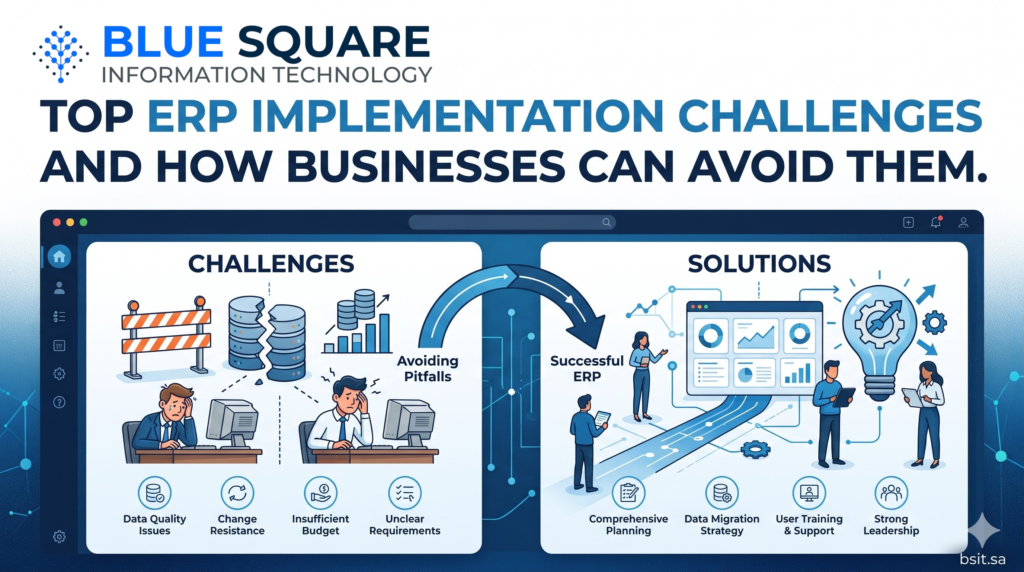
Enterprise Resource Planning (ERP) systems help organizations integrate finance, operations, procurement, inventory, human resources, and customer management into a single platform. However, despite their significant benefits, many businesses experience ERP Implementation Challenges due to poor planning, inadequate training, data issues, and lack of organizational readiness.
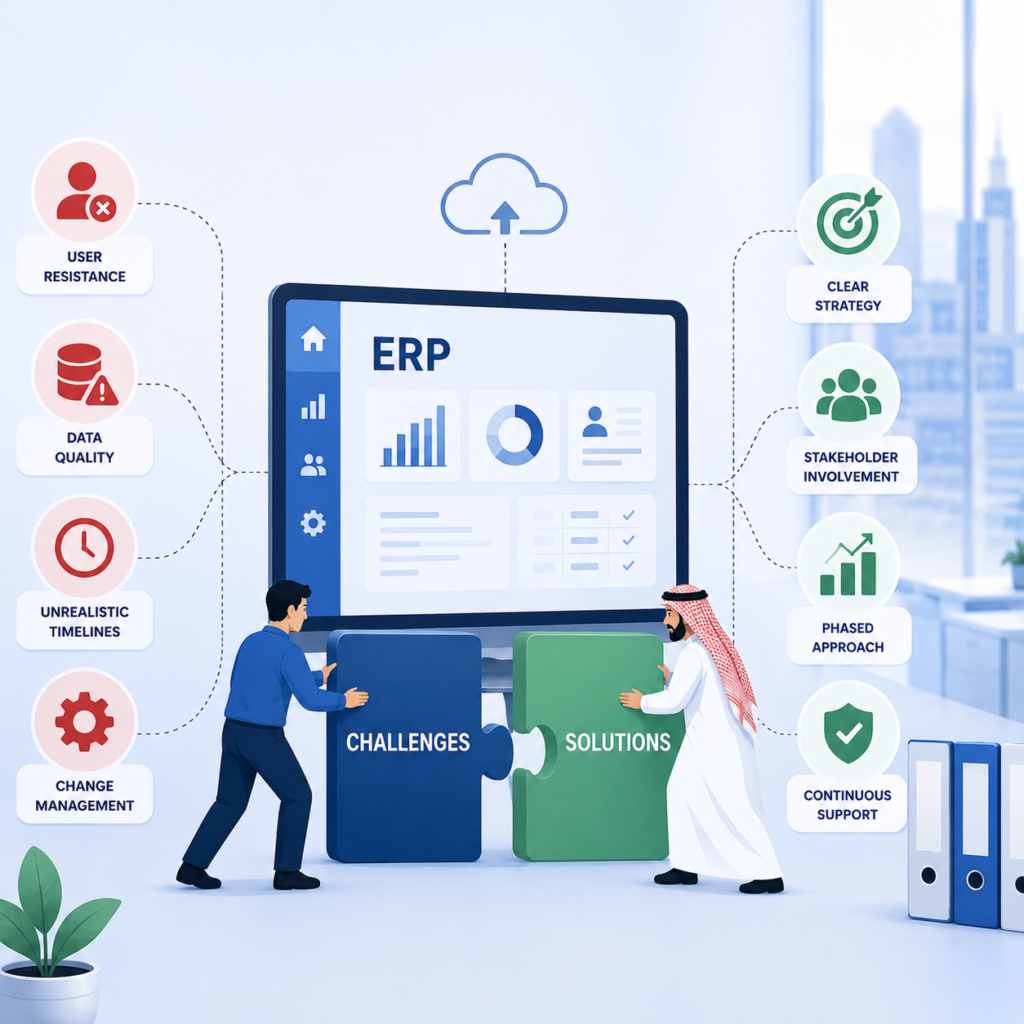
Understanding these challenges before starting an ERP project can significantly increase the chances of a successful deployment. With the right strategy, experienced implementation partners, and effective change management, businesses can maximize their ERP investment and accelerate digital transformation.
Why ERP Implementations Fail
ERP implementation is not only a technology project—it is a business transformation initiative involving processes, people, and data.
A successful ERP implementation requires careful planning, leadership commitment, and collaboration between departments.
1. Lack of Clear Business Requirements
The Challenge
Many organizations begin ERP implementation without fully understanding their existing processes and future business requirements. This can result in unnecessary customizations, project delays, and increased costs.
How to Avoid It
Before selecting and implementing an ERP system:
Analyze current workflows
Identify business pain points
Define measurable project goals
Create a detailed requirements document
Involve stakeholders from all departments
A structured discovery phase ensures that the ERP solution aligns with organizational objectives.
2. Choosing the Wrong ERP Solution
The Challenge
Not every ERP platform is suitable for every business. Choosing software that does not match industry requirements, company size, or future growth can create long-term operational problems.
How to Avoid It
Evaluate ERP solutions based on:
Industry-specific functionality
Scalability
Vendor support
Integration capabilities
Customization options
Businesses in Saudi Arabia should also consider local implementation expertise and ongoing support when selecting an ERP partner.
BSIT provides ERP implementation, customization, migration, integration, and managed support services to help organizations adopt the right ERP platform for their business requirements.
Learn more about BSIT ERP solutions:
3. Poor Data Migration
The Challenge
Moving data from legacy systems into a new ERP platform is one of the biggest ERP Implementation Challenges. Inaccurate, duplicate, or incomplete data can negatively affect reporting and business operations.
How to Avoid It
Develop a detailed data migration strategy:
Clean existing data before migration
Remove duplicate records
Standardize data formats
Perform multiple migration tests
Validate data after transfer
4. Employee Resistance and Lack of Training
The Challenge
ERP systems change how employees perform daily activities. Without proper communication and training, users may resist the new system.
How to Avoid It
Organizations should:
Communicate project benefits early
Provide role-based training
Create user guides and documentation
Offer continuous support after deployment
Effective change management improves user adoption and helps businesses achieve better ERP outcomes.
5. Insufficient Executive Support
The Challenge
ERP projects require decisions across multiple departments. Without leadership involvement, projects may suffer from lack of direction and resource limitations.
How to Avoid It
Ensure that executives:
Define clear project objectives
Allocate sufficient budget and resources
Participate in major decisions
Encourage organization-wide adoption
Strong leadership helps keep ERP projects aligned with business goals.
6. Excessive Customization
The Challenge
Although ERP systems provide flexibility, too many custom changes can increase implementation time, cost, and maintenance complexity.
How to Avoid It
Businesses should follow standard ERP best practices wherever possible and customize only when necessary for critical business requirements.
Experienced ERP consultants can help organizations balance customization with long-term maintainability.
7. Integration Difficulties with Existing Systems
The Challenge
Organizations often need ERP systems to connect with applications such as CRM platforms, document management systems, payroll software, and third-party applications.
Poor integration planning can create data silos and inefficient workflows.
How to Avoid It
Select ERP solutions that support reliable integrations and plan integration requirements during the early project stages.
Organizations can also integrate ERP with AI-powered document management systems to streamline document workflows, improve accessibility, and automate business processes.
Explore BSIT AI eDMS solutions.
8. Inadequate Testing Before Go-Live
The Challenge
Launching an ERP system without thorough testing can lead to operational disruptions and unexpected errors.
How to Avoid It
Conduct comprehensive testing, including:
Functional testing
User acceptance testing (UAT)
Integration testing
Performance testing
A carefully planned go-live strategy minimizes business interruptions.
9. Lack of Post-Implementation Support
The Challenge
ERP implementation does not end after deployment. Organizations require continuous monitoring, optimization, and technical assistance.
How to Avoid It
Choose an ERP partner that provides long-term support, system improvements, and performance optimization.
BSIT offers managed IT and ERP support services to help organizations maintain reliable and high-performing enterprise environments.
Why Choose BSIT for ERP Implementation in Saudi Arabia?
Successful ERP implementation requires more than software installation—it requires business expertise, technical knowledge, and long-term support.
BSIT helps organizations across Saudi Arabia implement modern ERP solutions with a customer-focused approach and local support.
Our ERP services include:
ERP consulting and planning
ERP implementation
System customization
Data migration
Third-party integrations
Ongoing managed support
User training
With expertise in ERP, AI solutions, cloud technologies, and enterprise services, BSIT helps businesses reduce implementation risks and achieve faster digital transformation.
Contact BSIT to build a successful ERP implementation strategy tailored to your business needs.