

Table of Contents
ToggleAI Analytics Manufacturing: How AI Is Transforming Modern Manufacturing
Introduction
Manufacturing companies generate vast amounts of data from production lines, ERP systems, supply chains, quality inspections, and equipment sensors. However, collecting data alone does not improve performance. The real value comes from converting that information into actionable insights.
AI Analytics Manufacturing combines artificial intelligence, machine learning, and advanced analytics to help manufacturers monitor operations in real time, predict equipment failures, improve product quality, and optimize production planning. Instead of relying solely on historical reports, manufacturers gain predictive insights that support faster and more informed business decisions.
As manufacturers in Saudi Arabia continue investing in Industry 4.0 and Vision 2030 initiatives, AI-powered analytics is becoming a key driver of operational excellence and sustainable growth.
What Is AI Analytics Manufacturing?
AI Analytics Manufacturing refers to the use of artificial intelligence and advanced analytics to analyze production, operational, and business data within manufacturing environments.
Unlike traditional reporting systems, AI-powered analytics can:
Predict equipment failures
Monitor production performance
Identify quality issues
Forecast demand
Optimize inventory
Improve resource utilization
Generate executive dashboards
These capabilities help manufacturers move from reactive operations to proactive decision-making.
Why Manufacturers Need AI Analytics
Manufacturers face increasing pressure to improve productivity while controlling costs and maintaining product quality.
Common challenges include:
Unplanned machine downtime
Rising production costs
Supply chain disruptions
Quality control issues
Inventory imbalances
Delayed reporting
Limited visibility across multiple plants
AI Analytics Manufacturing addresses these challenges by delivering real-time operational insights and predictive recommendations that improve efficiency across the organization.
9 Benefits of AI Analytics Manufacturing
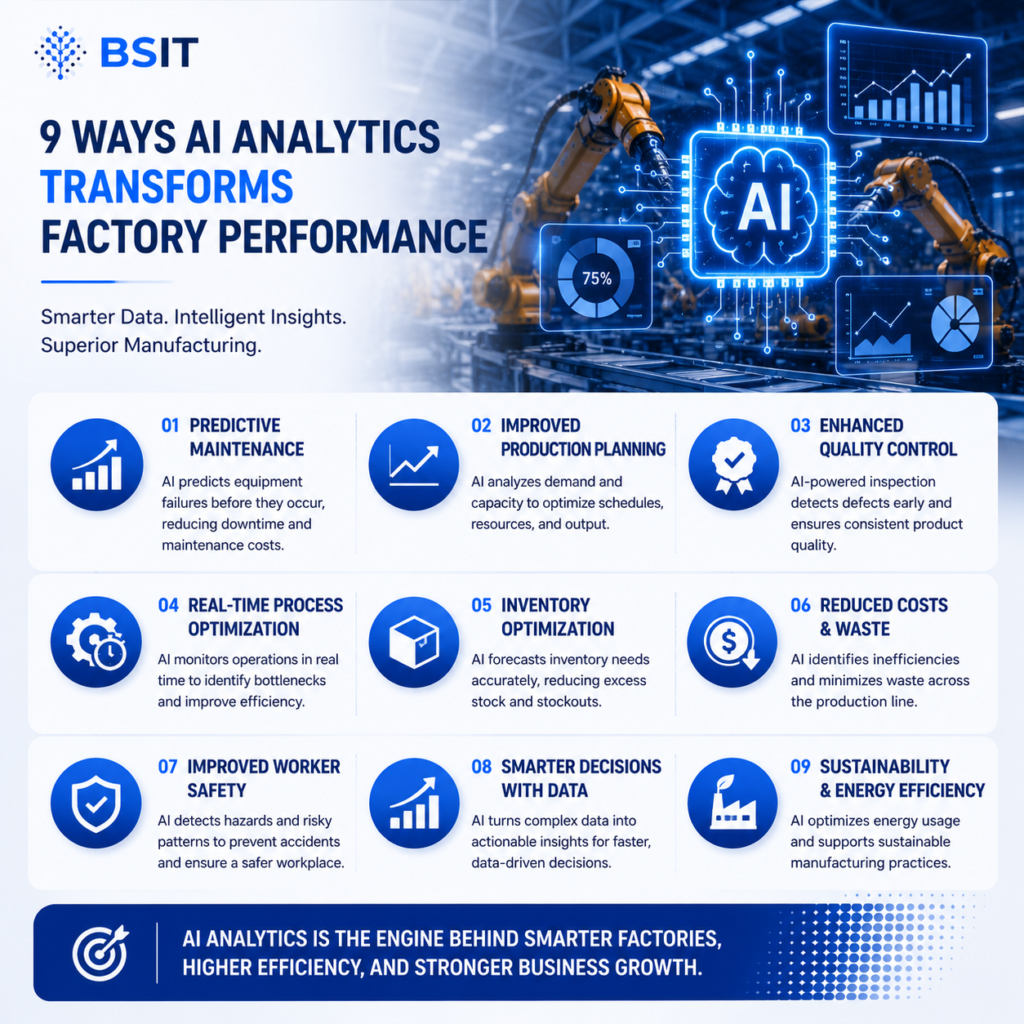
1. Predictive Maintenance
AI analyzes machine data to identify early signs of equipment failure, helping manufacturers schedule maintenance before costly breakdowns occur.
2. Improved Production Efficiency
Real-time analytics identify production bottlenecks, enabling managers to optimize workflows and increase throughput.
3. Better Quality Control
AI detects quality deviations during production, reducing defects and minimizing waste.
4. Smarter Inventory Management
Demand forecasting helps manufacturers maintain optimal inventory levels while reducing carrying costs.
5. Enhanced Supply Chain Visibility
AI provides insights into supplier performance, logistics, and procurement risks to improve supply chain resilience.
6. Faster Executive Reporting
Executives gain access to live dashboards displaying KPIs across production, finance, operations, and supply chain performance.
7. Reduced Operational Costs
By optimizing maintenance schedules, energy usage, and production planning, AI helps reduce overall operating expenses.
8. Improved Workforce Productivity
Managers can monitor labor utilization, production targets, and operational efficiency through centralized dashboards.
9. Data-Driven Strategic Planning
AI forecasting enables leadership teams to make informed investment decisions based on production trends, demand forecasts, and financial performance.
Real-World Applications
Manufacturing companies use AI Analytics Manufacturing to support:
Production planning
Predictive maintenance
Quality assurance
Inventory optimization
Demand forecasting
Energy consumption monitoring
Supply chain analytics
Executive KPI dashboards
For holding companies operating multiple manufacturing facilities, AI analytics provides enterprise-wide visibility into the performance of every plant, enabling leadership to benchmark operations and identify improvement opportunities.
Choosing the Right AI Analytics Platform
An effective manufacturing analytics platform should provide:
Real-time dashboards
ERP and MES integration
Predictive analytics
AI-powered forecasting
Custom KPI dashboards
Multi-plant reporting
Secure cloud deployment
Executive-level reporting
According to McKinsey & Company, manufacturers adopting AI-driven analytics can significantly improve productivity, optimize maintenance, and enhance operational performance by making better use of industrial data.
Why Choose BSIT's SIA Analytics Platform?
Manufacturers looking to transform operational data into business intelligence can benefit from BSIT’s SIA Analytics Platform, an AI-powered analytics solution that delivers real-time dashboards, predictive insights, executive reporting, and enterprise-wide performance monitoring. The platform helps manufacturing leaders identify production trends, optimize resource utilization, and improve strategic decision-making across multiple facilities.
For organizations already using enterprise resource planning software, BSIT also provides ERP Solutions that integrate seamlessly with analytics platforms, enabling manufacturers to consolidate production, finance, procurement, inventory, and supply chain data into a unified decision-making environment.
Frequently Asked Questions
What is AI Analytics Manufacturing?
AI Analytics Manufacturing uses artificial intelligence and advanced analytics to analyze production, operational, and business data, helping manufacturers improve efficiency, quality, and decision-making.
How does AI improve manufacturing operations?
AI helps manufacturers predict equipment failures, optimize production schedules, monitor quality, forecast demand, and reduce operational costs through data-driven insights.
Can AI analytics integrate with ERP systems?
Yes. Modern AI analytics platforms integrate with ERP, MES, CRM, and supply chain systems to provide a unified view of manufacturing performance.