
Table of Contents
ToggleAI Analytics Saudi Arabia: Top Use Cases Transforming Business Decision-Making
Introduction
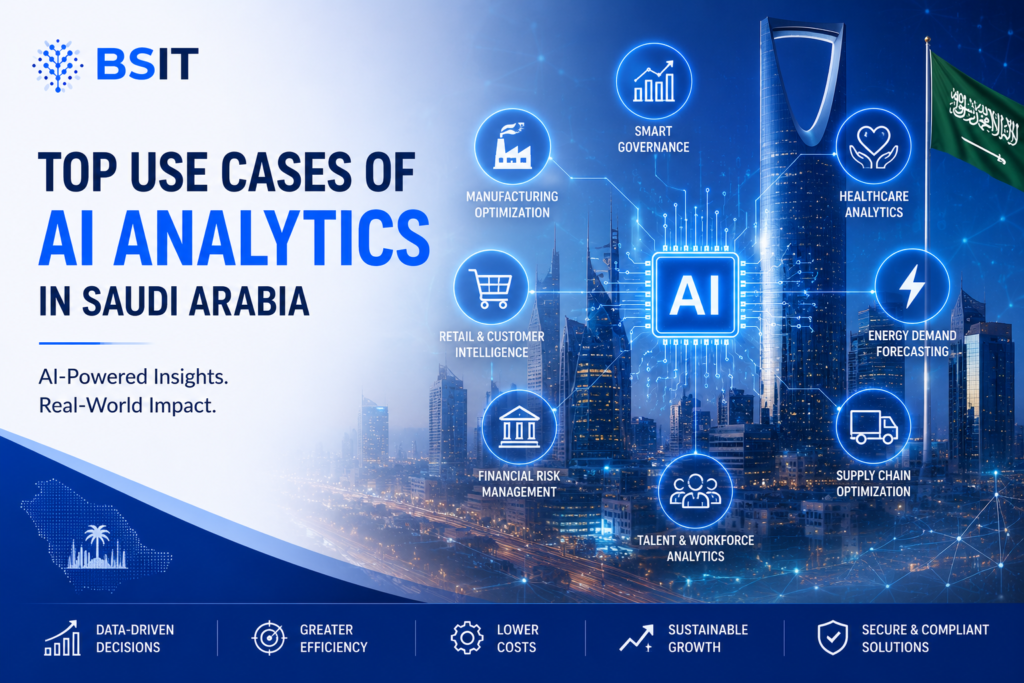
Saudi Arabia is rapidly embracing artificial intelligence as part of its Vision 2030 strategy to build a digitally driven economy. Organizations across manufacturing, healthcare, construction, retail, logistics, finance, and government are investing in AI technologies to improve operational efficiency and make faster, data-driven decisions.
Among these technologies, AI Analytics has emerged as one of the most valuable business tools. Rather than relying on static reports or manually compiled spreadsheets, organizations can analyze large volumes of operational data in real time, uncover hidden trends, predict future outcomes, and monitor key performance indicators (KPIs) from a single platform.
For enterprise groups and holding companies operating multiple subsidiaries, AI analytics provides a consolidated view of business performance, enabling executives to make informed strategic decisions with confidence.
Why AI Analytics Is Growing in Saudi Arabia
Organizations are generating more business data than ever before through ERP systems, CRM platforms, financial software, production systems, and cloud applications. However, turning this data into actionable insights remains a challenge.
Saudi Arabia’s continued investment in digital transformation and smart technologies is increasing demand for AI-powered analytics that can:
Improve executive decision-making
Monitor business performance in real time
Forecast future trends
Reduce operational risks
Support enterprise-wide digital transformation
AI analytics enables organizations to move beyond historical reporting and adopt proactive, insight-driven management.
What Is AI Analytics?
AI Analytics combines artificial intelligence, machine learning, and advanced data analysis to help organizations identify patterns, predict future outcomes, and generate actionable business insights.
Unlike traditional business intelligence tools that primarily explain past performance, AI analytics can:
Predict business trends
Detect anomalies
Forecast demand
Recommend actions
Monitor KPIs in real time
Automate executive reporting
This allows leadership teams to make faster and more informed decisions based on current and predictive information.
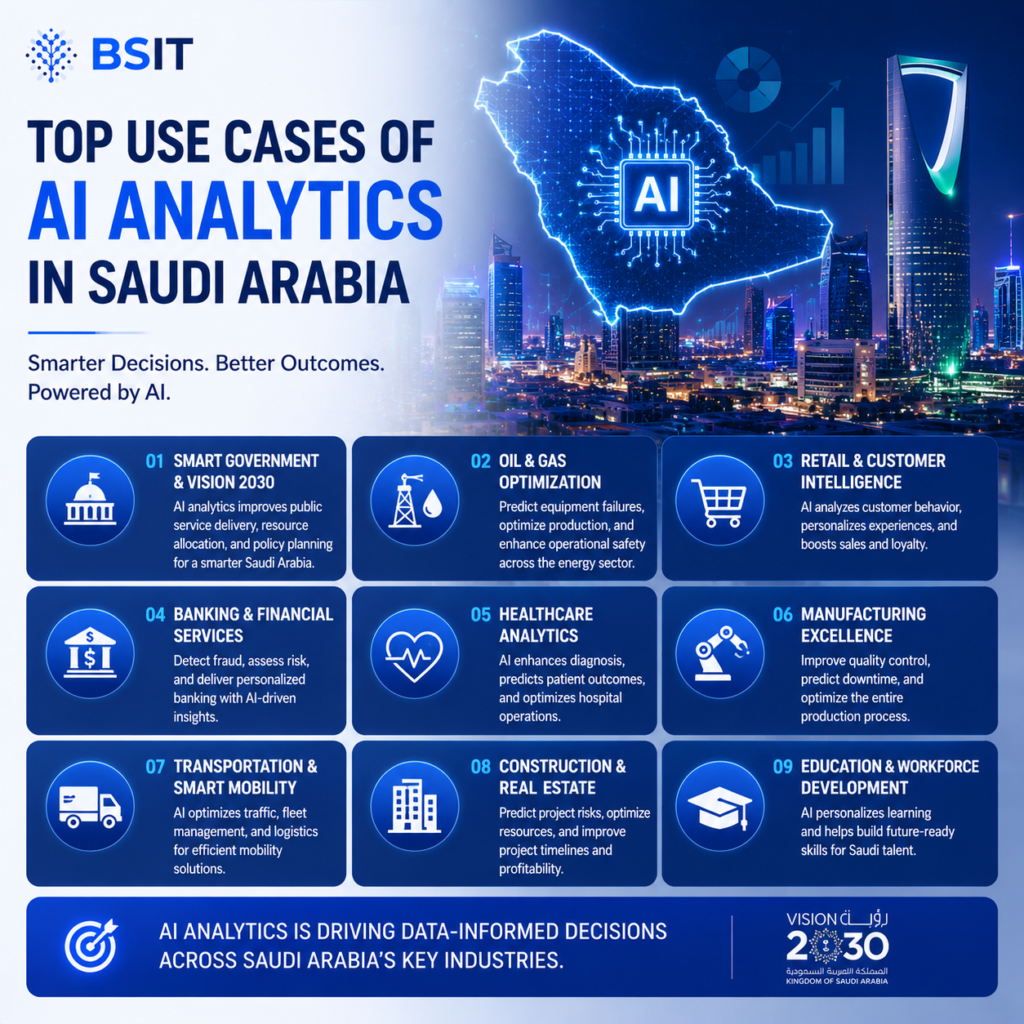
Top 10 AI Analytics Use Cases in Saudi Arabia
1. Executive Performance Dashboards
Holding company executives can monitor financial and operational performance across multiple subsidiaries through centralized dashboards.
2. Financial Planning and Forecasting
AI analyzes historical financial data to forecast revenue, expenses, cash flow, and profitability, helping finance teams improve planning accuracy.
3. Manufacturing Performance Monitoring
Manufacturers use AI analytics to optimize production, reduce downtime, monitor quality, and improve operational efficiency.
4. Retail Demand Forecasting
Retail businesses predict customer demand, optimize inventory levels, and improve sales planning using AI-driven forecasting models.
5. Construction Project Analytics
Construction companies monitor project costs, timelines, equipment utilization, and resource allocation to improve project delivery.
6. Healthcare Performance Analytics
Hospitals and healthcare providers analyze patient volumes, operational efficiency, and resource utilization to improve service delivery.
7. Supply Chain Optimization
Organizations gain visibility into procurement, logistics, warehouse operations, and supplier performance while identifying potential disruptions before they impact operations.
8. Human Resources Analytics
HR departments monitor workforce productivity, employee turnover, recruitment performance, and training effectiveness through AI-powered dashboards.
9. Customer Behavior Analysis
Sales and marketing teams analyze purchasing patterns, customer preferences, and engagement metrics to improve customer experiences and increase revenue.
Why Enterprise Leaders Need AI Analytics
Business leaders need more than historical reports—they need visibility into what is happening now and what is likely to happen next.
AI analytics empowers executives to:
Monitor enterprise-wide KPIs
Compare subsidiary performance
Improve investment decisions
Optimize resource allocation
Detect risks early
Support strategic planning
For holding companies, centralized analytics eliminates information silos and creates a single source of truth across multiple business units.
Choosing the Right AI Analytics Platform
When selecting an AI analytics solution, organizations should evaluate whether it provides:
Real-time dashboards
ERP integration
Predictive analytics
Executive KPI dashboards
Interactive visualizations
Multi-plant reporting
Cloud and hybrid deployment options
Secure role-based access
According to research by the McKinsey Global Institute, AI has the potential to significantly improve productivity and decision-making by helping organizations analyze large volumes of data, automate repetitive tasks, and support faster, more informed business decisions. For enterprises, AI-powered analytics enables leadership teams to identify trends earlier, optimize operations, and allocate resources more effectively.
Why Choose BSIT's Analytics Platform?
Organizations seeking enterprise-wide visibility can leverage BSIT’s SIA Analytics Platform, an AI-powered analytics solution that provides real-time dashboards, predictive analytics, executive reporting, and KPI monitoring. Designed for enterprise organizations and holding companies, the platform helps leadership consolidate data from multiple systems into a unified decision-making environment, enabling faster and more informed strategic decisions.
For organizations looking to make business data even more accessible, BSIT also offers AI Chat With Database, allowing users to interact with ERP systems and enterprise databases using natural language to generate instant insights and dashboards. Together, these solutions simplify enterprise reporting while enhancing executive decision-making.
Frequently Asked Questions
What is AI Analytics?
AI Analytics uses artificial intelligence and machine learning to analyze business data, identify trends, generate forecasts, and support data-driven decision-making.
Which industries in Saudi Arabia benefit most from AI Analytics?
Manufacturing, construction, healthcare, retail, logistics, finance, education, and holding companies are among the industries gaining significant value from AI-powered analytics.
How does AI Analytics improve executive decision-making?
AI Analytics provides real-time dashboards, predictive insights, and enterprise-wide visibility, enabling executives to identify opportunities, monitor KPIs, and respond to business challenges more quickly.