
Table of Contents
ToggleAI Database Analytics: How Chat With Database Simplifies Business Reporting
Introduction
Business leaders rely on timely and accurate reports to monitor performance, identify opportunities, and make strategic decisions. However, traditional reporting often depends on IT teams, manual SQL queries, spreadsheets, or business intelligence specialists, creating delays when executives need answers quickly.
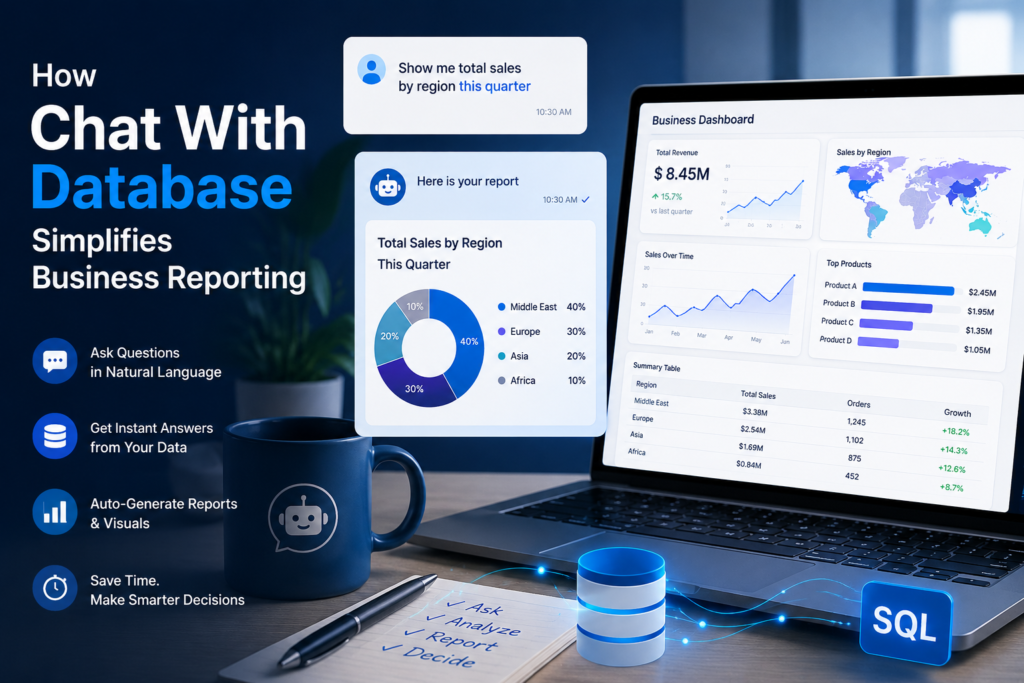
AI Database Analytics changes this approach by allowing users to interact with enterprise databases using natural language. Instead of writing complex queries or waiting for scheduled reports, decision-makers can simply ask questions such as “What were last month’s sales by region?” or “Which products generated the highest profit this quarter?” and receive instant, data-driven insights.
For organizations in Saudi Arabia embracing digital transformation, AI-powered database analytics enables faster reporting, greater operational visibility, and more informed business decisions.
What Is AI Database Analytics?
Database Analytics uses artificial intelligence, natural language processing (NLP), and machine learning to analyze information stored in enterprise databases and present meaningful insights in an easy-to-understand format.
Rather than requiring technical knowledge of SQL or database structures, users can retrieve information through conversational queries.
Typical capabilities include:
Natural language search
Automated report generation
Real-time dashboards
Trend analysis
KPI monitoring
Data visualization
Executive summaries
This makes business intelligence more accessible across departments, not just to technical users.
Why Traditional Business Reporting Falls Short
Many organizations still rely on conventional reporting processes that involve multiple manual steps.
Common challenges include:
Dependence on technical teams for database queries
Time-consuming report preparation
Limited real-time visibility
Difficulty consolidating data from multiple systems
Inconsistent reporting formats
Delayed executive decision-making
What Is AI Chat With Database?
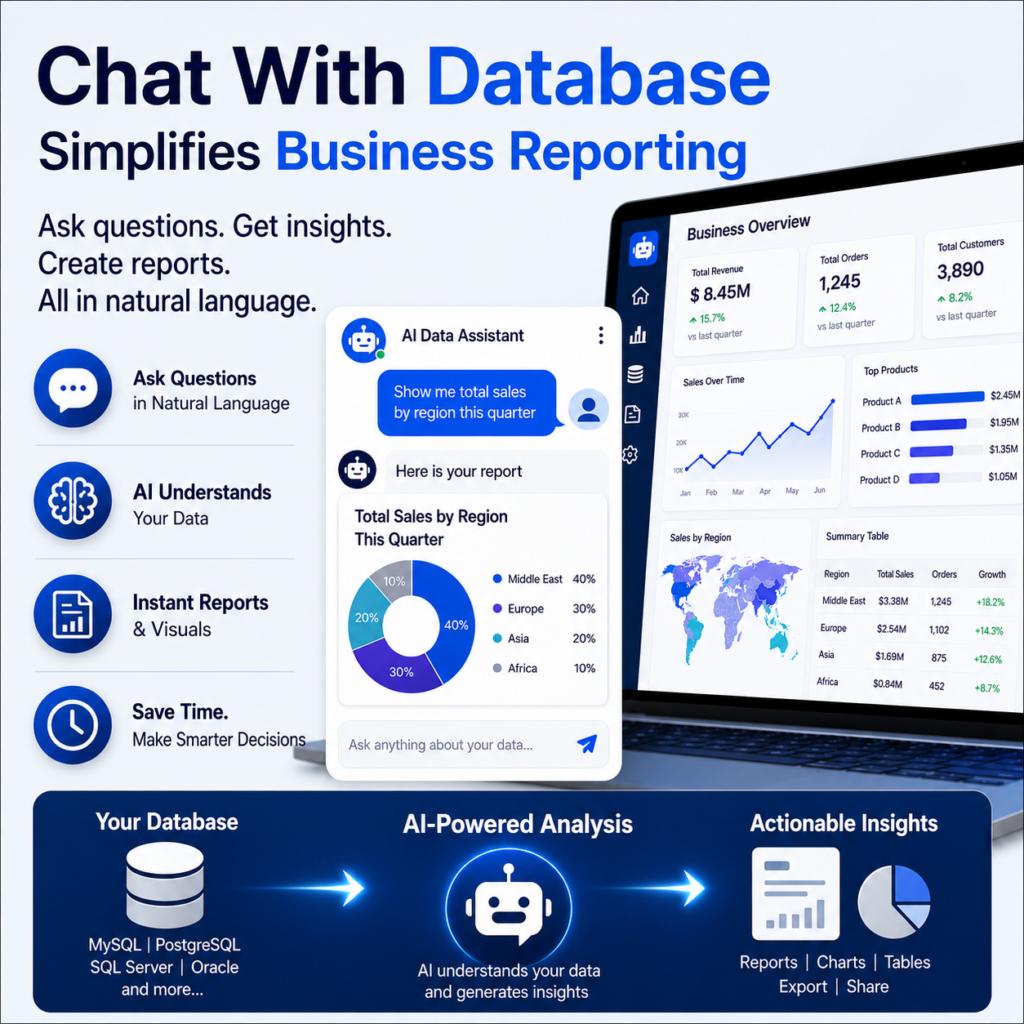
AI Chat With Database is a conversational analytics solution that enables users to ask questions in everyday language and receive instant answers from enterprise databases.
Instead of searching through dashboards or exporting spreadsheets, executives can ask questions like:
What were our total sales this month?
Which branch achieved the highest revenue?
How did operating expenses change compared to last quarter?
Which customers have overdue invoices?
What is the current inventory level?
The AI interprets the request, retrieves the relevant data, and presents the results in a clear and meaningful format.
8 Ways Chat With Database Simplifies Business Reporting
1. Natural Language Queries
Users can ask business questions without writing SQL or relying on technical specialists.
2. Instant Report Generation
Reports are generated within seconds, significantly reducing reporting delays.
3. Real-Time Business Insights
Executives access the latest available information rather than relying on outdated static reports.
4. Faster Decision-Making
Leadership teams can respond quickly to operational issues using live business intelligence.
5. Unified Data Access
The platform consolidates information from ERP, CRM, finance, HR, and other enterprise systems into a single reporting experience.
6. Improved Productivity
Business users spend less time requesting reports and more time acting on insights.
7. Better Executive Visibility
Interactive dashboards help executives monitor KPIs, revenue, expenses, operational performance, and business trends.
8. Scalable Enterprise Reporting
As organizations grow, AI-powered analytics continues to deliver fast, consistent reporting across departments and subsidiaries.
Real-World Business Applications
Organizations use AI Database Analytics across many business functions, including:
Executive performance reporting
Financial analysis
Sales reporting
Procurement monitoring
Inventory analysis
HR analytics
Customer service reporting
Multi-company performance dashboards
An enterprise-ready solution should provide:
Manufacturing companies use AI Analytics Manufacturing to support:
Natural language processing (NLP)
ERP and database integration
Secure role-based access
Real-time reporting
Interactive dashboards
AI-powered recommendations
Multi-company reporting
Cloud and on-premises deployment options
For holding companies operating multiple manufacturing facilities, AI analytics provides enterprise-wide visibility into the performance of every plant, enabling leadership to benchmark operations and identify improvement opportunities.
Why Choose BSIT's AI Chat With Database?
Organizations looking to simplify enterprise reporting can leverage BSIT’s AI Chat With Database, an intelligent solution that enables users to retrieve information from enterprise databases through natural language conversations. Instead of relying on manual reports or complex queries, business users can instantly access operational, financial, and performance insights, making analytics faster, more accessible, and easier to use across the organization.
For organizations seeking deeper executive analytics, BSIT also offers the SIA Analytics Platform, which complements conversational reporting with predictive analytics, KPI dashboards, and enterprise-wide performance monitoring, giving leadership a comprehensive view of business operations.
Frequently Asked Questions
What is AI Database Analytics?
AI Database Analytics uses artificial intelligence and natural language processing to help users analyze enterprise data, generate reports, and retrieve insights without writing database queries.
How does AI Chat With Database work?
Users ask business questions in natural language, and the AI interprets the request, retrieves information from connected databases, and presents the results in an understandable format.
Which businesses benefit from AI Database Analytics?
Organizations in manufacturing, healthcare, retail, logistics, finance, education, construction, and holding companies benefit from faster reporting, improved decision-making, and better access to enterprise data.