

Table of Contents
ToggleAI Data Analytics: How AI Analytics Improves Business Decision Making
Introduction
Modern enterprises generate enormous volumes of business data every day, yet many executive teams still struggle to convert that information into timely, strategic decisions. Different departments often rely on disconnected systems, spreadsheets, and manually prepared reports, making it difficult for leadership to obtain a complete view of business performance.
AI Data Analytics changes this by transforming enterprise data into actionable intelligence. Rather than simply displaying historical reports, AI-powered analytics identifies trends, predicts future outcomes, and delivers real-time insights that help executives make informed decisions with greater confidence
For holding companies managing multiple subsidiaries, AI analytics provides a centralized view of operations, enabling leadership to monitor performance across the entire organization from a single platform.
Why Executive Decision-Making Needs Better Data
Senior executives are expected to make decisions involving:
Investments
Business expansion
Operational efficiency
Risk management
Resource allocation
Financial performance
When information comes from separate ERP systems, spreadsheets, or manual reports, decision-making becomes slower and less reliable.
AI-powered analytics eliminates these information silos by bringing enterprise data together into executive dashboards.
What Is AI Data Analytics?
AI Data Analytics combines artificial intelligence, machine learning, and advanced analytics to process large volumes of structured and unstructured business data.
Unlike traditional reporting tools, AI analytics can:
Detect hidden patterns
Predict future performance
Identify operational risks
Recommend actions
Monitor KPIs in real time
Generate executive summaries
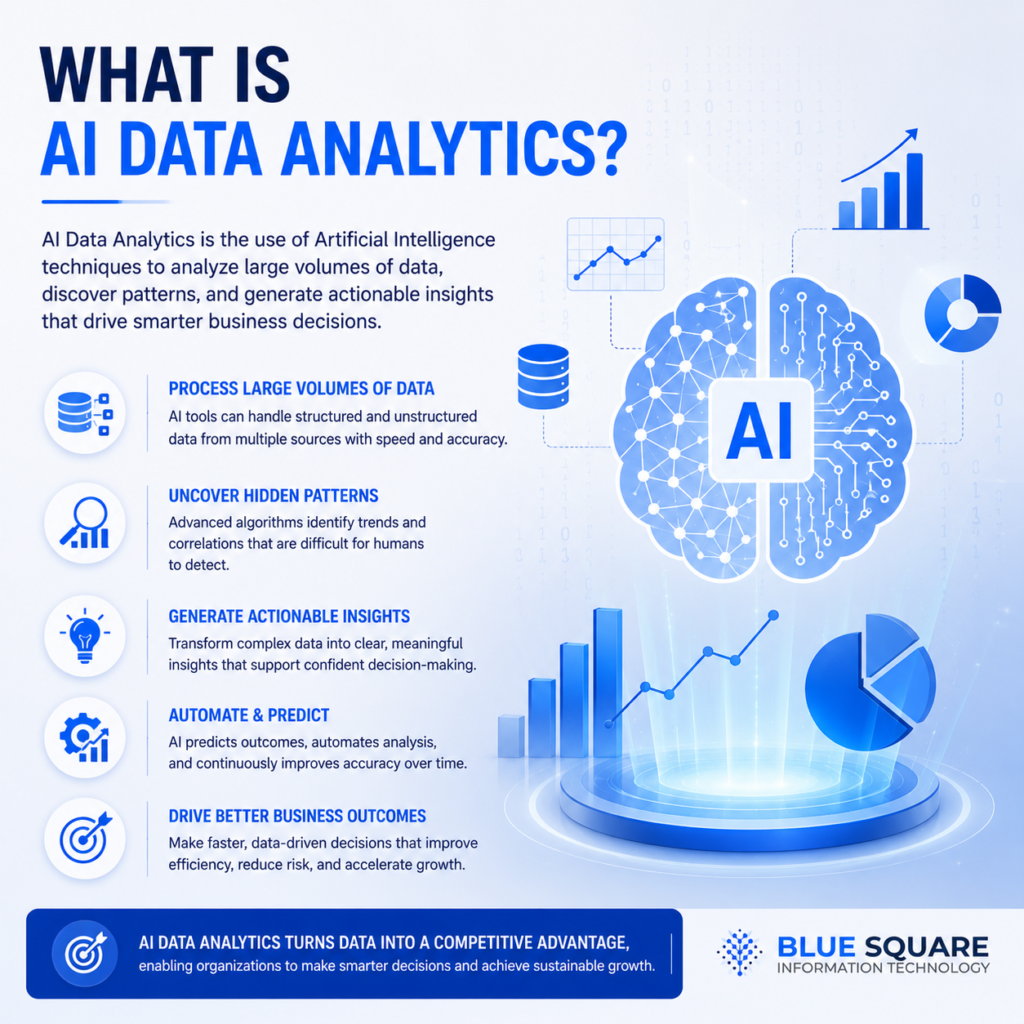
Instead of waiting for monthly reports, executives gain continuous access to live business intelligence.
Common Challenges for Holding Companies
Holding companies typically oversee multiple subsidiaries, each using different business applications and reporting methods.
Common challenges include:
Inconsistent reporting formats
Delayed management reports
Limited cross-company visibility
Manual data consolidation
Slow executive decision-making
Difficulty identifying underperforming business units
AI Data Analytics addresses these challenges by creating a unified decision intelligence platform.
9 Ways AI Data Analytics Improves Business Decisions
1. Enterprise-Wide Visibility
Executives can monitor performance across all subsidiaries through a single dashboard.
2. Real-Time Executive Dashboards
Leadership no longer waits for monthly reports to understand business performance.
3. Predictive Forecasting
AI identifies trends and predicts revenue, costs, and operational performance before issues arise.
4. Faster Strategic Decisions
Executives receive insights instantly instead of relying on manually prepared reports.
5. Better Risk Management
AI detects unusual business patterns, operational risks, and financial anomalies.
6. Improved Resource Allocation
Leadership can identify where investments and resources generate the greatest business value.
7. Smarter KPI Monitoring
Executives can track financial, operational, and strategic KPIs from one centralized platform.
8. Automated Executive Reporting
AI reduces the time spent preparing board reports by automatically generating dashboards and summaries.
9. Better Long-Term Planning
Historical data combined with predictive analytics helps organizations make more confident strategic decisions.
Executive Use Cases
AI Data Analytics supports executive decision-making across industries such as:
- Manufacturing
- Construction
- Healthcare
- Retail
- Logistics
- Education
- Distribution
- Holding Companies
Typical executive applications include:
- Group performance monitoring
- Subsidiary benchmarking
- Budget planning
- Cash flow forecasting
- Operational efficiency analysis
- Executive KPI dashboards
Why Choosing the Right AI Analytics Platform Matters
An enterprise AI analytics solution should provide:
- Real-time dashboards
- Multi-company reporting
- ERP integration
- Predictive analytics
- Interactive visualizations
- Role-based executive dashboards
- Secure cloud deployment
- AI-driven recommendations
According to McKinsey & Company, organizations that effectively use AI in decision-making can improve operational performance, increase productivity, and create stronger competitive advantages by making faster, data-driven decisions.
Why Choose BSIT's SIA Analytics Platform?
For organizations seeking executive-level visibility across multiple business units, BSIT’s SIA Analytics Platform delivers AI-powered decision intelligence designed for enterprise leadership. The platform provides real-time dashboards, predictive analytics, executive reporting, and business forecasting that help CEOs, CFOs, and holding company executives monitor performance across their organizations from a single interface.
Businesses can also integrate SIA with BSIT’s ERP Solutions, enabling executives to consolidate financial, operational, procurement, and HR data into unified dashboards that support faster strategic decision-making.
Frequently Asked Questions
What is AI Data Analytics?
AI Data Analytics uses artificial intelligence and machine learning to analyze business data, identify trends, predict future outcomes, and provide actionable insights for better decision-making.
How does AI analytics help CEOs?
AI analytics provides CEOs with real-time dashboards, predictive forecasts, and enterprise-wide visibility, enabling faster and more informed strategic decisions.
Can AI Data Analytics integrate with ERP systems?
Yes. Modern AI analytics platforms integrate with ERP, CRM, finance, HR, and other enterprise applications to provide a unified view of business performance.