
Table of Contents
ToggleAI Predictive Analytics: What Is It and Why Does It Matter?
Introduction
Businesses today generate enormous amounts of data, but historical reports alone are no longer enough to stay competitive. Leaders need insights into what is likely to happen next, not just what happened yesterday. This is where AI Predictive Analytics plays a critical role.
By combining artificial intelligence, machine learning, and advanced statistical models, AI Predictive Analytics helps organizations forecast trends, identify risks, anticipate customer behavior, and make proactive business decisions. Instead of reacting to problems after they occur, companies can act earlier, improve efficiency, and seize new opportunities.
For organizations in Saudi Arabia pursuing digital transformation, predictive analytics is becoming an essential capability for long-term growth and smarter decision-making.
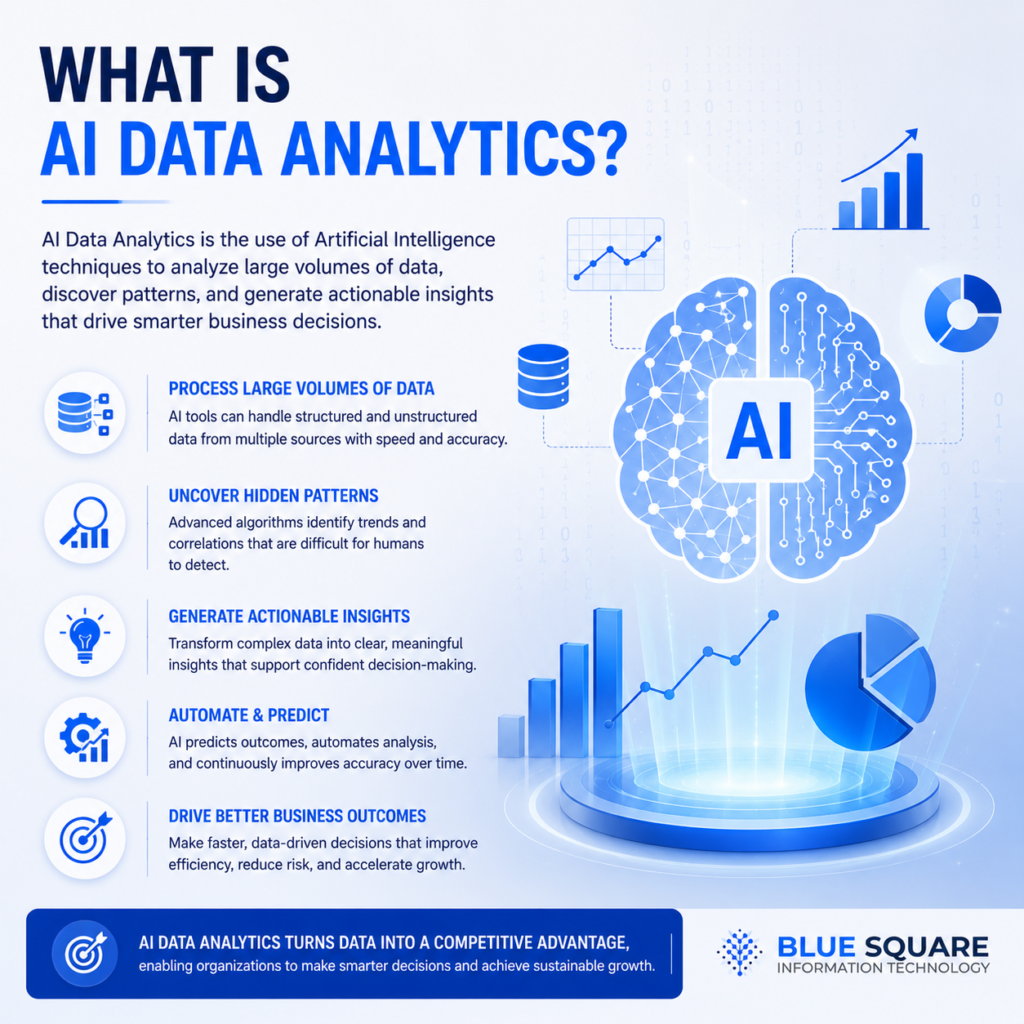
AI Data Analytics changes this by transforming enterprise data into actionable intelligence. Rather than simply displaying historical reports, AI-powered analytics identifies trends, predicts future outcomes, and delivers real-time insights that help executives make informed decisions with greater confidence
What Is AI Predictive Analytics?
AI Predictive Analytics is the use of artificial intelligence and machine learning algorithms to analyze historical and real-time data in order to predict future outcomes.
Unlike traditional reporting, which focuses on past performance, predictive analytics identifies patterns and estimates future events such as:
Customer demand
Sales performance
Equipment failures
Financial risks
Inventory requirements
Employee turnover
Market trends
These insights enable businesses to make informed decisions before challenges arise.
Why AI Predictive Analytics Matters
A predictive analytics solution typically follows these steps:
1. Data Collection
Data is gathered from ERP systems, CRM platforms, financial software, IoT devices, and other enterprise applications.
2. Data Preparation
The collected information is cleaned, organized, and standardized to improve analytical accuracy.
3. Machine Learning Analysis
AI algorithms identify relationships, patterns, and trends that humans may overlook.
4. Forecast Generation
The system generates predictions, forecasts, and recommendations based on historical and current data.
5. Continuous Improvement
As new data becomes available, AI models continuously learn and improve prediction accuracy over time.
Why AI Predictive Analytics Matters
Organizations today operate in rapidly changing markets where timely decisions are critical. Relying solely on historical reports often delays responses to emerging opportunities and risks.
With AI Predictive Analytics, executives can:
Forecast business performance
Optimize resource allocation
Reduce operational risks
Improve customer satisfaction
Strengthen financial planning
Make faster strategic decisions
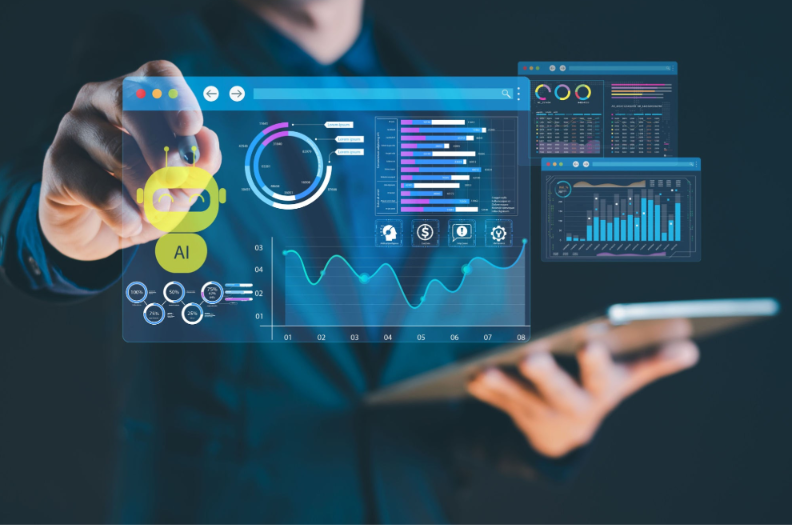
Rather than relying on intuition alone, leadership teams can support decisions with data-driven forecasts.
8 Business Benefits of AI Predictive Analytics
1. More Accurate Business Forecasting
AI analyzes historical trends and current market conditions to produce more reliable forecasts.
2. Better Risk Management
Organizations can identify potential financial, operational, or supply chain risks before they impact business performance.
3. Improved Customer Experience
Predictive models help businesses anticipate customer preferences and personalize products or services.
4. Smarter Inventory Management
Demand forecasting reduces stock shortages, excess inventory, and unnecessary operational costs.
5. Faster Executive Decision-Making
Executives gain access to predictive dashboards that support timely strategic planning.
6. Higher Operational Efficiency
AI identifies bottlenecks and recommends process improvements that increase productivity.
7. Revenue Growth Opportunities
Businesses can uncover sales trends, identify new markets, and optimize pricing strategies using predictive insights.
8. Competitive Advantage
Organizations that anticipate market changes can respond faster than competitors and make more informed investment decisions.
Real-World Applications of AI Predictive Analytics
Predictive analytics delivers measurable value across industries:
- Manufacturing: Predictive maintenance and production planning.
- Retail: Demand forecasting and inventory optimization.
- Healthcare: Patient risk assessment and resource planning.
- Construction: Project scheduling and cost forecasting.
- Financial Services: Fraud detection and credit risk analysis.
- Logistics: Route optimization and delivery forecasting.
- Education: Student performance analytics and resource allocation.
For holding companies, predictive analytics enables executives to compare subsidiary performance, forecast growth, and monitor enterprise-wide KPIs from a unified dashboard.
Challenges and Best Practices
While predictive analytics offers significant benefits, organizations should consider:
- Ensuring high-quality data
- Integrating data from multiple systems
- Defining measurable business objectives
- Regularly updating AI models
- Training employees to interpret predictive insights
A successful implementation combines advanced technology with strong governance and clear business goals.
According to IBM, predictive analytics uses historical and current data, statistical algorithms, and machine learning techniques to forecast future outcomes, enabling organizations to improve planning, optimize operations, and reduce uncertainty.
Why Choose BSIT's SIA Analytics Platform?
Organizations seeking to transform enterprise data into actionable insights can leverage BSIT’s SIA Analytics Platform, an AI-powered solution designed for executive decision intelligence. The platform provides real-time dashboards, predictive analytics, business forecasting, and executive reporting, helping leadership teams monitor performance, identify trends, and make confident strategic decisions.
For businesses that rely on ERP systems, SIA integrates with enterprise applications to consolidate operational, financial, and business data into a single source of truth. This allows executives to move beyond historical reporting and benefit from predictive, AI-driven decision support.
Frequently Asked Questions
What is AI Data Analytics?
AI Data Analytics uses artificial intelligence and machine learning to analyze business data, identify trends, predict future outcomes, and provide actionable insights for better decision-making.
How does AI analytics help CEOs?
AI analytics provides CEOs with real-time dashboards, predictive forecasts, and enterprise-wide visibility, enabling faster and more informed strategic decisions.
Can AI Data Analytics integrate with ERP systems?
Yes. Modern AI analytics platforms integrate with ERP, CRM, finance, HR, and other enterprise applications to provide a unified view of business performance.