
Table of Contents
Toggle9 Steps ERP Implementation Process for Businesses in Saudi Arabia
Businesses across Saudi Arabia are investing in digital transformation to improve efficiency, reduce operational costs, and stay competitive in a rapidly evolving market. As organizations grow, managing finance, procurement, inventory, sales, human resources, and operations through separate systems becomes increasingly difficult.
This is where Enterprise Resource Planning (ERP) systems play a critical role.
A successful ERP Implementation Saudi Arabia project helps businesses integrate departments, automate workflows, improve reporting, and gain real-time visibility across operations. However, achieving these benefits requires a structured implementation process.
In this guide, we explain the ERP implementation process, common challenges, and best practices for Saudi businesses planning to deploy an ERP solution.
Why ERP Implementation Is Important for Saudi Businesses
Saudi Arabia’s Vision 2030 initiative is accelerating digital transformation across industries including manufacturing, construction, healthcare, retail, logistics, and education.
Many organizations still rely on spreadsheets, disconnected software applications, and manual processes that create:
- Data duplication
- Reporting delays
- Inventory inaccuracies
- Limited visibility across departments
- Increased operational costs
An ERP system addresses these challenges by creating a centralized platform where all business functions work together.
Benefits of ERP implementation include:
- Improved operational efficiency
- Automated business processes
- Better inventory management
- Real-time reporting
- Enhanced financial control
- Improved compliance and governance
- Faster decision-making
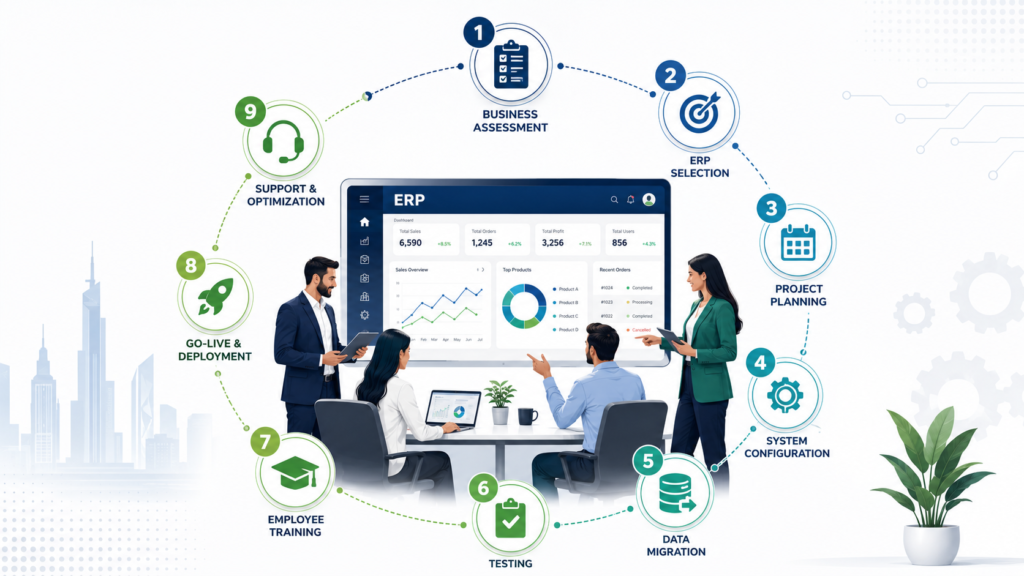
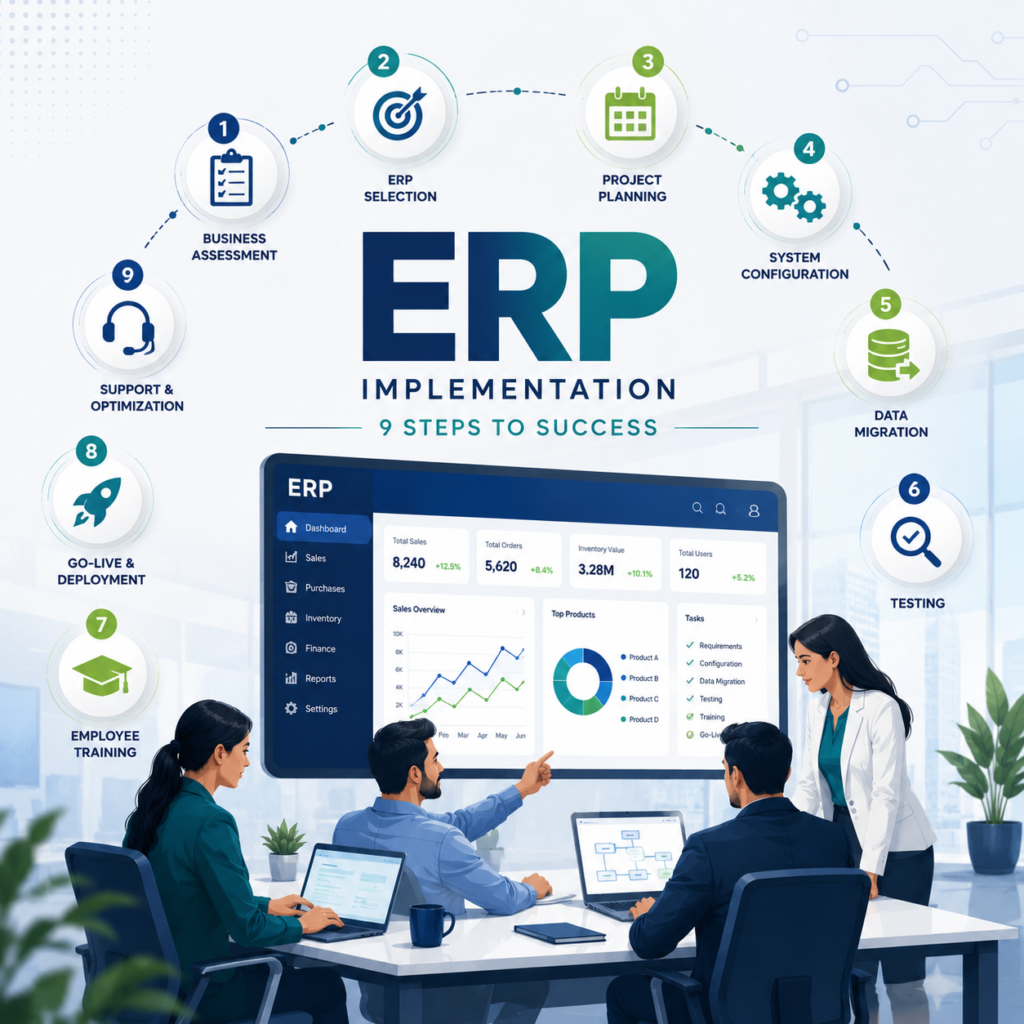
9 Steps ERP Implementation Process
A successful ERP implementation follows a structured approach. Skipping steps often leads to delays, budget overruns, and user adoption issues.
Step 1: Business Assessment and Requirement Gathering
The first stage of any ERP Implementation Saudi Arabia project is understanding the organization’s current processes and objectives.
This phase involves:
- Departmental discussions
- Process analysis
- Pain point identification
- Future growth planning
- Reporting requirements assessment
The goal is to determine what the business needs from its ERP system and which processes require improvement.
Organizations that spend sufficient time on requirements gathering typically achieve better implementation outcomes.
Step 2: ERP Solution Selection
Not every ERP solution is suitable for every business.
For example, a manufacturing company may require production planning and quality management modules, while a trading company may prioritize inventory and procurement functionality.
Selecting the right ERP platform is one of the most important decisions in the implementation journey.
Not every ERP solution is suitable for every business.
Key evaluation factors include:
- Industry requirements
- Number of users
- Scalability
- Integration capabilities
- Cloud or on-premise deployment
- Customization requirements
- Vendor support
Step 3: Project Planning
After selecting an ERP solution, the implementation team creates a detailed project plan.
This typically includes:
- Project scope
- Timeline
- Resource allocation
- Risk management
- Budget planning
- Milestones and deliverables
Clear planning helps reduce implementation risks and ensures all stakeholders understand their responsibilities.
Step 4: Process Design and System Configuration
ERP systems should support optimized business processes rather than replicate inefficient workflows.
During this phase:
- Business workflows are reviewed
- Approval hierarchies are defined
- User roles are configured
- Reports and dashboards are designed
- ERP modules are configured
The objective is to align the ERP system with operational requirements while following industry best practices.
Step 5: Data Migration
Data migration is often one of the most challenging parts of ERP implementation.
Organizations typically migrate:
- Customer records
- Supplier data
- Inventory information
- Financial records
- Product catalogs
- Employee information
Before migration, businesses should:
- Remove duplicate records
- Correct inaccurate data
- Standardize formats
- Validate information
Clean data improves reporting accuracy and overall ERP performance.
Step 6: Testing
Before going live, the ERP system must be thoroughly tested.
Testing helps identify issues that could impact business operations.
Common testing activities include:
Functional Testing
Verifies individual ERP modules perform as expected.
Integration Testing
Ensures different modules communicate correctly.
User Acceptance Testing (UAT)
Allows employees to validate real-world business scenarios before deployment.
Testing reduces risk and improves confidence before launch.
Lorem ipsum dolor sit amet, consectetur adipiscing elit. Ut elit tellus, luctus nec ullamcorper mattis, pulvinar dapibus leo.
Step 7: Employee Training
Even the best ERP system can fail if employees do not understand how to use it.
Training should focus on:
- Daily workflows
- Data entry standards
- Reporting functions
- Approval processes
- Department-specific activities
Organizations that invest in training often achieve higher user adoption and faster returns on investment.
Step 8: Go-Live and Deployment
After testing and training are completed, the ERP system is deployed.
Businesses generally choose between:
Big Bang Approach
All modules are launched simultaneously.
Phased Approach
Modules are implemented gradually over time.
Many Saudi businesses prefer a phased implementation approach because it reduces operational risks.
Step 9: Post-Implementation Support
ERP implementation does not end after deployment.
Continuous support is essential for:
- Performance monitoring
- User assistance
- Process optimization
- Additional module implementation
- Reporting enhancements
Organizations that continuously improve their ERP environment achieve greater long-term value.
Common ERP Implementation Challenges
While ERP systems deliver significant benefits, implementation projects can face challenges.
Lack of Clear Objectives
Without defined business goals, ERP projects often lose direction.
Poor Data Quality
Migrating inaccurate data creates reporting and operational issues.
User Resistance
Employees may hesitate to adopt new systems if change management is neglected.
Insufficient Training
Limited training can reduce user confidence and productivity.
Scope Creep
Adding new requirements during implementation can increase costs and delays.
Working with an experienced ERP implementation partner helps minimize these risks.
ERP Implementation Timeline
Implementation timelines depend on organization size and project complexity.
| Business Size | Typical ERP Implementation Timeline |
| Small Business | 2–4 Months |
| Medium Business | 4–8 Months |
| Large Enterprise | 8–18 Months |
A realistic timeline is important for project success and stakeholder expectations.
How BSIT Helps Businesses Implement ERP Successfully
Implementing ERP requires technical expertise, business process knowledge, and ongoing support.
BSIT helps organizations through:
- ERP consulting and assessment
- Business process analysis
- ERP implementation services
- Data migration support
- User training
- System integration
- Post-implementation support
With a strong understanding of Saudi business requirements, BSIT helps organizations achieve successful ERP deployments while minimizing risks and disruptions.