
Table of Contents
ToggleERP ROI: Measuring the Business Value of ERP Systems
What Is ERP ROI?
ERP ROI refers to the measurable return a business receives after investing in an Enterprise Resource Planning (ERP) system. It evaluates whether the financial and operational benefits gained from ERP implementation outweigh the costs of purchasing, deploying, maintaining, and optimizing the system.
A strong ERP return on investment is not measured only by reduced costs. It also includes increased productivity, faster decision-making, improved data accuracy, enhanced customer service, and better resource utilization.
Key Factors That Influence ERP ROI
Several factors determine the overall ERP implementation ROI:
1. Reduced Operational Costs
ERP systems automate repetitive processes, reducing manual effort, minimizing errors, and lowering administrative expenses.
2. Increased Employee Productivity
Employees spend less time searching for information or managing spreadsheets, allowing them to focus on high-value activities.
3. Improved Decision-Making
Real-time dashboards and analytics provide management with accurate insights for faster strategic decisions.
4. Better Inventory and Resource Management
ERP helps organizations maintain optimal inventory levels, reduce waste, and improve resource allocation.
5. Enhanced Customer Experience
Integrated business data allows faster response times, accurate order tracking, and improved service quality.
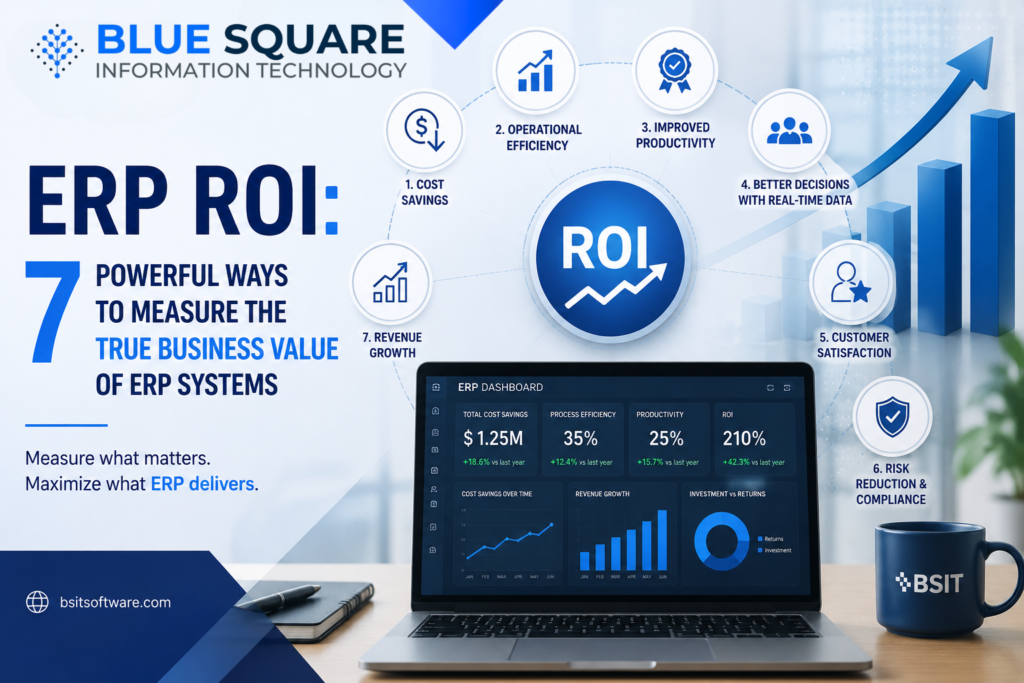
7 Powerful Ways to Measure ERP ROI and Business Value
1. Track Cost Savings
Compare expenses before and after ERP implementation, including labor, inventory, and administrative costs.
2. Measure Productivity Improvements
Analyze the time saved through workflow automation and streamlined business processes.
3. Evaluate Revenue Growth
A successful ERP system can support sales efficiency, customer satisfaction, and business expansion.
4. Monitor Process Efficiency
Measure how quickly tasks such as procurement, reporting, and approvals are completed.
6. Assess Long-Term Strategic Benefits
The long-term ERP return on investment includes scalability, business agility, compliance support, and improved competitiveness.
5. Analyze Data Accuracy
Reduced errors and a single source of business information contribute significantly to ERP business value.
7. Calculate Return on Investment Metrics
Use standard calculations such as:
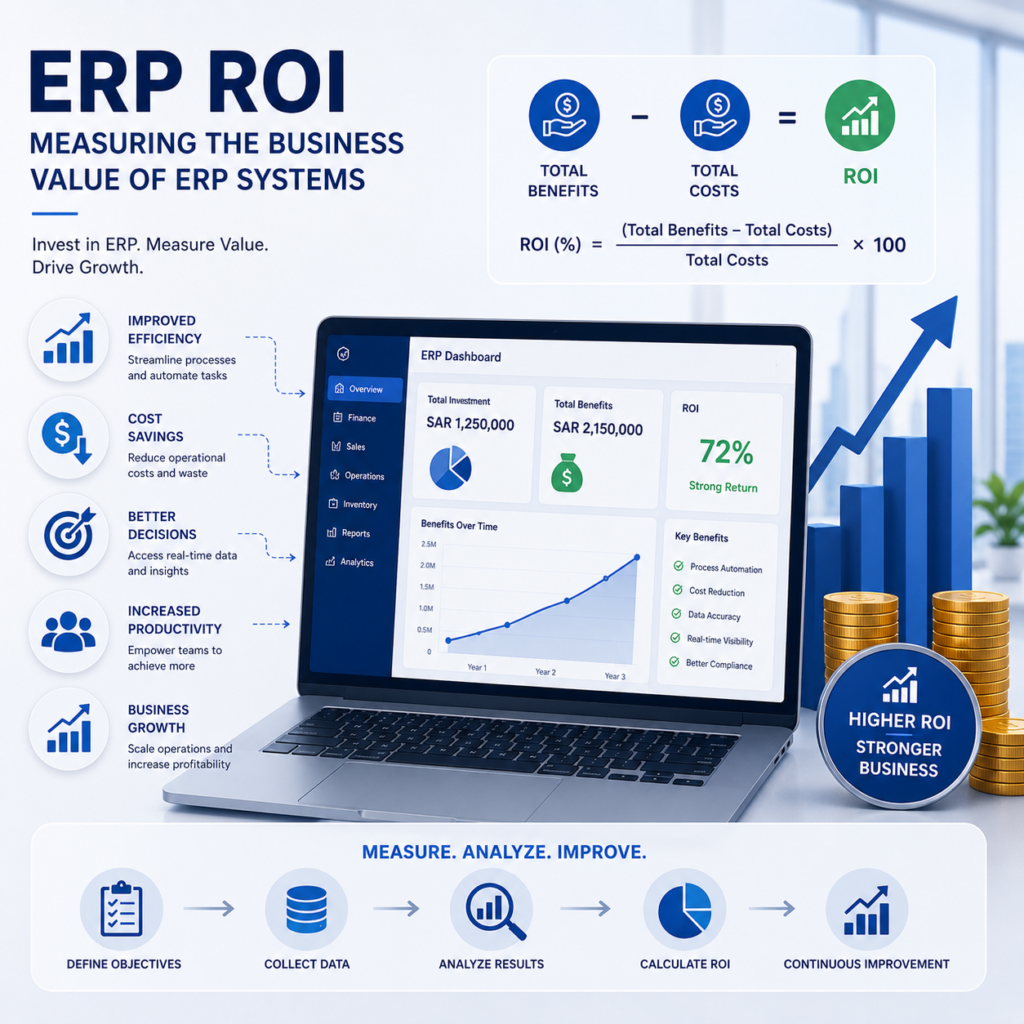
ERP ROI (%) = [(Total Benefits – Total ERP Costs) ÷ Total ERP Costs] × 100
This helps organizations quantify the financial impact of their ERP investment.
Common Challenges in Measuring ERP ROI
Many businesses struggle to measure ERP ROI because some benefits are indirect or appear over time.
Common challenges include:
Lack of clear KPIs before implementation
Focusing only on financial gains
Ignoring productivity improvements
Poor user adoption
Insufficient employee training
Setting measurable objectives before ERP deployment helps organizations accurately evaluate success.
How to Maximize ERP ROI
Companies can improve ERP ROI by selecting the right technology partner, aligning the system with business processes, providing proper training, and continuously optimizing the platform.
Research by Deloitte highlights that organizations focusing on digital transformation and technology adoption can create greater operational efficiency and long-term value.
External Source:
https://www.deloitte.com/
Why Choose BSIT for ERP Implementation?
BSIT empowers enterprises with AI-driven innovation and digital transformation through enterprise technology solutions, including ERP implementation, customization, migration, system integration, and managed support services.
Our ERP experts help organizations implement scalable solutions aligned with their operational goals, enabling improved efficiency, automation, and measurable business value.
Explore BSIT ERP solutions:
Frequently Asked Questions
How long does it take to achieve ERP ROI?
The timeline depends on the organization’s size, implementation scope, and adoption rate. Many businesses begin seeing measurable ERP benefits within months, while long-term strategic value continues to grow over several years.
What is a good ERP ROI percentage?
A good ERP ROI varies by industry and business goals. The ideal ERP investment should generate measurable cost savings, productivity improvements, and operational advantages that exceed implementation costs.
How can companies improve ERP ROI?
Businesses can improve ERP ROI by choosing the right ERP solution, training employees, defining KPIs, optimizing workflows, and partnering with experienced ERP implementation providers.